
HetrixTools is a low-cost uptime and status page service aimed at small teams and MSPs. It offers uptime monitoring, basic server monitoring via a small agent, and white-label status pages, all at a price that is hard to beat for budget-conscious setups.
The limit is depth and integration. HetrixTools gives you several monitors (uptime, server) in one account, but they feel disconnected, and the server metrics are shallow compared to a real monitoring platform. For teams that want a single operational picture instead of a panel of siloed monitors, Simple Observability bundles uptime, metrics, logs, and cron monitoring at a fixed per-server price.
This article covers the best alternatives to HetrixTools in 2026. We stay within the uptime and monitoring category, so you will not see enterprise APM platforms here, just tools that solve the same problem HetrixTools solves. If you are comparing other tools, see our UptimeRobot alternatives and Uptime Kuma alternatives guides.
Quick summary
| Tool | Best For | Price Model |
|---|---|---|
| Simple Observability | Unified operational picture | $3 / mo / server |
| UptimeRobot | Simple managed uptime | Free / $9+/mo |
| Pingdom | Polished managed uptime | $15 / mo (10 checks) |
| StatusCake | Managed uptime + SSL + speed | Free / $20+/mo |
| Better Stack | Status pages & on-call | Usage based |
| Uptime Kuma | Self-hosted uptime | Free (OSS) |
| Upptime | Free, GitHub Actions uptime | Free (OSS) |
| Healthchecks.io | Cron job monitoring | Free / $5+/mo |
HetrixTools Overview
Known for
HetrixTools is best known for being a cheap, white-label-friendly uptime and status page service. It is popular with MSPs who want to resell monitoring under their own brand, and with small teams that want a generous free tier.
Key features
- Uptime monitoring: HTTP, keyword, ping, and port checks.
- Status pages: Public, white-label status pages.
- Server monitoring: Basic resource metrics via a small agent.
- Notifications: Email, Slack, Telegram, and more.
Why look for a HetrixTools alternative?
While HetrixTools is cheap, several limits push teams to look elsewhere.
1. Disconnected monitors
Uptime checks, server metrics, and status pages live in separate panels within HetrixTools. You get the pieces, but not a single operational picture that ties a server’s health to its uptime and its status page.
2. Shallow server metrics
The server monitoring agent reports basic resource numbers, but it is far less deep than a dedicated infrastructure platform. For real troubleshooting, you need another tool for the detail.
3. No logs
HetrixTools does not do log management. When an uptime check fails and you want to see the logs that explain it, you are in a different tool.
4. No cron monitoring
There is no heartbeat-based cron monitoring. If silent cron job failures are a concern, you need a separate tool for that too.
How to choose an alternative?
When comparing HetrixTools competitors, focus on what you want around uptime.
- Unified vs siloed: Decide whether you want a single operational picture or separate monitors.
- Depth of metrics: If shallow server metrics are the pain, look for a real infrastructure platform.
- Logs and cron: If logs or cron monitoring matter, check whether the tool includes them natively.
- White-label: If you are an MSP, check whether white-label status pages are a requirement.
8 Best HetrixTools Alternatives
1. Simple Observability
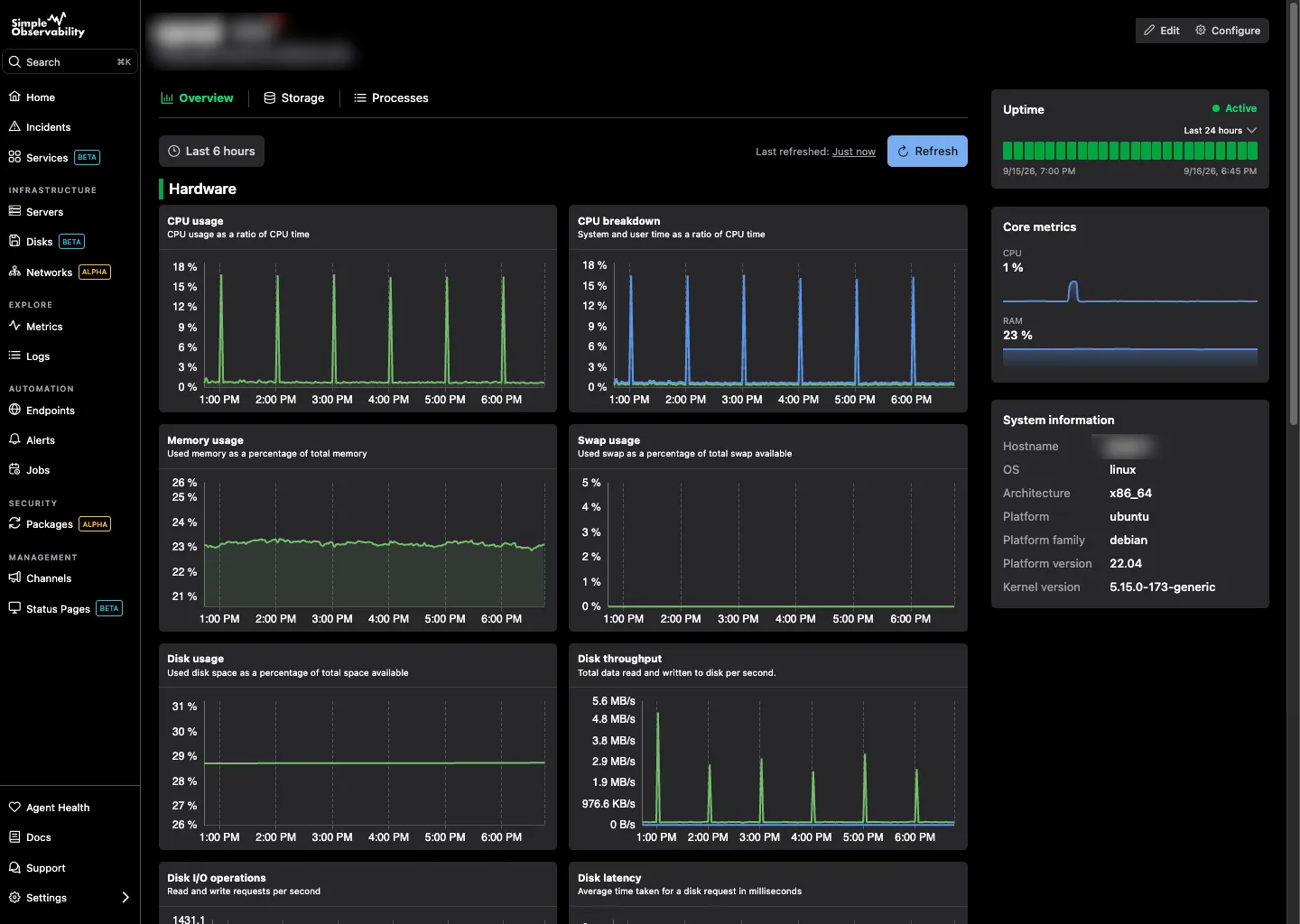
Simple Observability is built for teams that want a single operational picture instead of a panel of disconnected monitors. It bundles uptime, server metrics, logs, and cron monitoring in one dashboard, at a fixed per-server price.
Key features
- Unified dashboard: Uptime, CPU, memory, disk, logs, and cron in one view.
- Zero-config alerts: Sensible defaults from day one.
- Lightweight agent: An open-source agent installed with one command.
- Hosted: The agent pushes data out over HTTPS, no inbound ports.
Simple Observability vs HetrixTools Where HetrixTools gives you disconnected uptime, server, and status page monitors, Simple Observability gives you one unified view. You get deeper server metrics, plus logs and cron monitoring that HetrixTools does not offer, at a predictable per-server price.
Pros
- All-in-one: Uptime, metrics, logs, and cron in one dashboard.
- Deeper metrics: Real infrastructure data, not shallow resource numbers.
- Predictable pricing: Flat fee per server.
Cons
- No white-label status pages: HetrixTools offers white-label pages for MSPs; Simple Observability does not.
- Not free: HetrixTools has a free tier; Simple Observability is free for 1 server then $3/server.
Best for: Teams that want a single operational picture with metrics, logs, and cron, without reselling needs.
Price
- Free: $0 for 1 server.
- Paid: $3/mo per server for unlimited servers.
- Custom: Volume discounts for large fleets.
2. UptimeRobot
UptimeRobot is a simple, managed uptime monitoring service. It is a direct competitor to HetrixTools on the uptime side, with a similar free tier.
Key features
- Multiple check types: HTTP, keyword, ping, TCP port.
- Free tier: 50 monitors at 5-minute intervals.
- Status pages: Public status pages on paid plans.
- Notifications: Email, webhook, Slack, Discord, and more.
Pros
- Dead simple: Set up a monitor in seconds.
- Free tier: Genuinely useful for small setups.
- Managed: No self-hosted monitor to maintain.
Cons
- No white-label: Status pages are not white-label on lower tiers, unlike HetrixTools.
- Uptime only: No metrics, logs, or server context.
Best for: Teams that want a managed uptime tool similar to HetrixTools.
Price Free for 50 monitors. Paid plans start around $9/month.
3. Pingdom
Pingdom is a long-established, managed uptime and performance monitoring service. It is the polished commercial alternative to HetrixTools for teams that want a SaaS uptime tool.
Key features
- Uptime and transaction checks: HTTP, ping, and multi-step transactions.
- Page speed insights: Real browser performance reports, beyond simple uptime.
- Status pages: Public, branded status pages.
- Alerting: SMS, email, and webhook notifications.
Pros
- Polished and mature: A well-known, enterprise-friendly uptime tool.
- Transaction checks: Multi-step checks that HetrixTools does not offer.
- Page speed: Adds performance context that pure uptime tools lack.
Cons
- No free tier: Unlike HetrixTools, Pingdom has no free plan.
- Per-check pricing: The entry plan covers 10 checks, and costs scale per check.
- Uptime only: No server metrics, logs, or cron.
Best for: Teams that want a polished, managed uptime tool with transaction checks and page speed.
Price Starts at around $15/month for 10 checks. Higher tiers add transaction checks and SMS credits.
4. StatusCake
StatusCake is a managed uptime monitoring SaaS with a free tier. It competes with HetrixTools on price, while adding SSL, page-speed, and domain checks.
Key features
- Uptime tests: HTTP, ping, TCP, and SSL checks.
- Page speed and SSL: Built-in speed and certificate monitoring.
- Status pages: Public status pages.
- Free tier: 10 uptime tests at 5-minute intervals.
Pros
- SSL and speed on free: Covers more than just uptime, even on the free tier.
- Managed: No server to run.
Cons
- Interval limits on free: Free tests run at 5-minute intervals.
- No white-label: Less MSP-friendly than HetrixTools on lower tiers.
- Uptime and speed only: No server metrics, logs, or cron.
Best for: Teams that want managed uptime plus SSL and speed checks on a free tier.
Price Free for 10 uptime tests. Paid plans start around $20/month for 100 tests at 1-minute intervals.
5. Better Stack
Better Stack is a monitoring and incident management platform that combines uptime checks, structured logging, and branded status pages.
Key features
- Status pages: Branded, hosted status pages out of the box.
- Uptime monitoring: Heartbeat and HTTP checks with on-call alerting.
- Structured logging: Centralized log search with alerting.
Pros
- Polished UX: A step up from HetrixTools’ functional but plain interface.
- Logs alongside uptime: Context HetrixTools does not provide.
- On-call workflows: Scheduling and alert routing.
Cons
- Per-volume log pricing: Ingest is billed by volume if you use logs.
- Thin metrics: Infrastructure metrics are not its strength.
Best for: Teams that want polished status pages and on-call workflows with logs.
Price Free tier available. Paid plans are usage-based.
6. Uptime Kuma
Uptime Kuma is a self-hosted, open-source uptime monitor. It is the self-hosting alternative to HetrixTools for teams that want full control and no per-monitor pricing.
Key features
- Self-hosted: Runs on your own server via Docker or Node.
- Many monitor types: HTTP, TCP, ping, DNS, container, and push checks.
- Notifications: A wide range of channels.
- Status pages: Basic public status pages.
Pros
- Free and open source: No per-monitor pricing.
- Flexible: More check types than HetrixTools, including push heartbeats.
Cons
- Self-hosted: You maintain the instance, including its uptime.
- No white-label status pages: Less MSP-friendly than HetrixTools.
- Uptime only: No metrics, logs, or server context.
Best for: Self-hosters who want a free, controllable uptime monitor.
Price Free (open source).
7. Upptime
Upptime is a free, open-source uptime monitor that runs entirely on GitHub Actions and GitHub Pages. It is the closest free alternative to HetrixTools for teams that want zero maintenance and a free status page.
Key features
- GitHub Actions powered: Checks run on a schedule inside a GitHub repo.
- Status page on GitHub Pages: A generated, hosted status page, free.
- Notifications: Slack, email, and more via GitHub Actions.
- History and SLA: Response time history and SLA reporting.
Pros
- Free forever: No per-monitor pricing, no server.
- Zero maintenance: GitHub runs the checks and hosts the status page.
- Open source: Fully auditable and customizable.
Cons
- GitHub rate limits: Check frequency is limited by GitHub Actions scheduling.
- Uptime only: No metrics, logs, or server context.
- Requires a GitHub account: The whole system lives in a repo.
Best for: Teams and open-source projects that want a free, zero-maintenance uptime monitor with a status page.
Price Free (open source, runs on GitHub’s free tiers).
8. Healthchecks.io
Healthchecks.io is a cron job monitor. It is not a direct uptime competitor, but it belongs here because many teams searching for a HetrixTools alternative also need cron monitoring.
Key features
- Cron monitoring: Pings for scheduled job success and failure.
- Alerts: Email, Slack, webhook, and more on missed runs.
- Free tier: Up to 20 checks for free.
Pros
- Solves a real gap: Silent cron failures are easy to miss otherwise.
- Free tier: Useful for small setups.
Cons
- Cron only: No uptime, metrics, or logs.
- Single-purpose: One tool in a stack, like HetrixTools’ separate monitors.
Best for: Teams whose real need is cron monitoring, not general uptime.
Price Free for 20 checks. Paid plans start around $5/month.
Conclusion
HetrixTools is a great budget choice if you want cheap uptime and white-label status pages, and you accept shallow metrics and disconnected monitors. The alternatives split into three groups: managed uptime tools (UptimeRobot, Pingdom, StatusCake), self-hosted or free uptime (Uptime Kuma, Upptime), and platforms that add a unified picture (Simple Observability, Better Stack).
- For a unified picture with depth: Try Simple Observability. Uptime, metrics, logs, and cron in one dashboard.
- For a polished managed uptime tool: Pingdom or StatusCake are the direct peers.
- For a free, self-hosted uptime tool: Uptime Kuma (server) or Upptime (GitHub Actions).
Pick the tool that gives you a connected picture, not a panel of separate monitors. For a head-to-head breakdown, see our HetrixTools comparison page, and for the uptime angle, our Uptime Kuma alternatives guide goes deeper.