





Monitoring used to mean setting up a server to watch your other servers. In 2026, that model has largely collapsed under the weight of cloud-native complexity. When your infrastructure is spread across three continents and dozens of managed services, the last thing you need is to manage the monitoring stack itself.
Cloud based monitoring tools (SaaS) have become the standard because they decouple your visibility from your infrastructure. They don’t go down when your data center does, and they scale automatically as your clusters grow. However, the market is now so crowded that “finding a tool” has turned into a multi-month evaluation project.
The real challenge today isn’t collecting data. It is filtering the noise and avoiding the “monitoring tax” — the hours your team spends configuring dashboards instead of shipping code. For related reading, see our DevOps monitoring tools comparison and managed monitoring guide.
The shift to cloud based monitoring
Traditional on-prem monitoring requires you to host your own time-series databases, manage retention policies, and patch your own security vulnerabilities. In a cloud-first world, this is a distraction. SaaS monitoring platforms allow you to offload the storage and processing of trillions of telemetry points to a specialized provider.
This shift is driven by three main factors. First, the ephemeral nature of cloud resources (like Lambda functions or Kubernetes pods) makes manual configuration impossible. Second, multi-cloud strategies require a “single pane of glass” that can aggregate data from AWS, Azure, and GCP simultaneously. Finally, the move toward unified observability means teams want logs, metrics, and traces in one place, not three separate silos.
Key evaluation criteria for 2026
Before choosing a platform, you need to look past the marketing screenshots. The best cloud monitoring tools in 2026 are defined by how they handle three specific areas.
Telemetry correlation
A spike in CPU usage is useless without context. Can the tool automatically link that spike to a specific log error or a slow database trace? If you have to manually line up timestamps between two different browser tabs, the tool is failing you.
Multi-cloud native support
Most vendors claim multi-cloud support, but the depth varies. You need a tool that doesn’t just “support” AWS, but understands managed services like RDS, SQS, and Lambda out of the box. The integration should be as simple as a one-click IAM role connection.
Predictable pricing
The “Datadog effect” is real. Many cloud based monitoring tools use complex ingestion-based pricing that results in a bill that grows faster than your revenue. Look for tools that offer flat, host-based, or highly transparent usage models.
7 best cloud based monitoring tools comparison
| Tool | Best for | Key differentiator |
|---|---|---|
| Simple Observability | Fast-moving teams | Zero-config metrics & logs |
| Datadog | Large Enterprises | 600+ integrations |
| New Relic | App-heavy stacks | Deep APM & RUM |
| Dynatrace | Root-cause focus | AI-driven Davis engine |
| Grafana Cloud | OSS enthusiasts | Managed Prometheus/Loki |
| AWS CloudWatch | AWS-only shops | Native, no-setup basic logs |
| Azure Monitor | Windows/Azure teams | Deep integration with MS stack |
1. Simple Observability
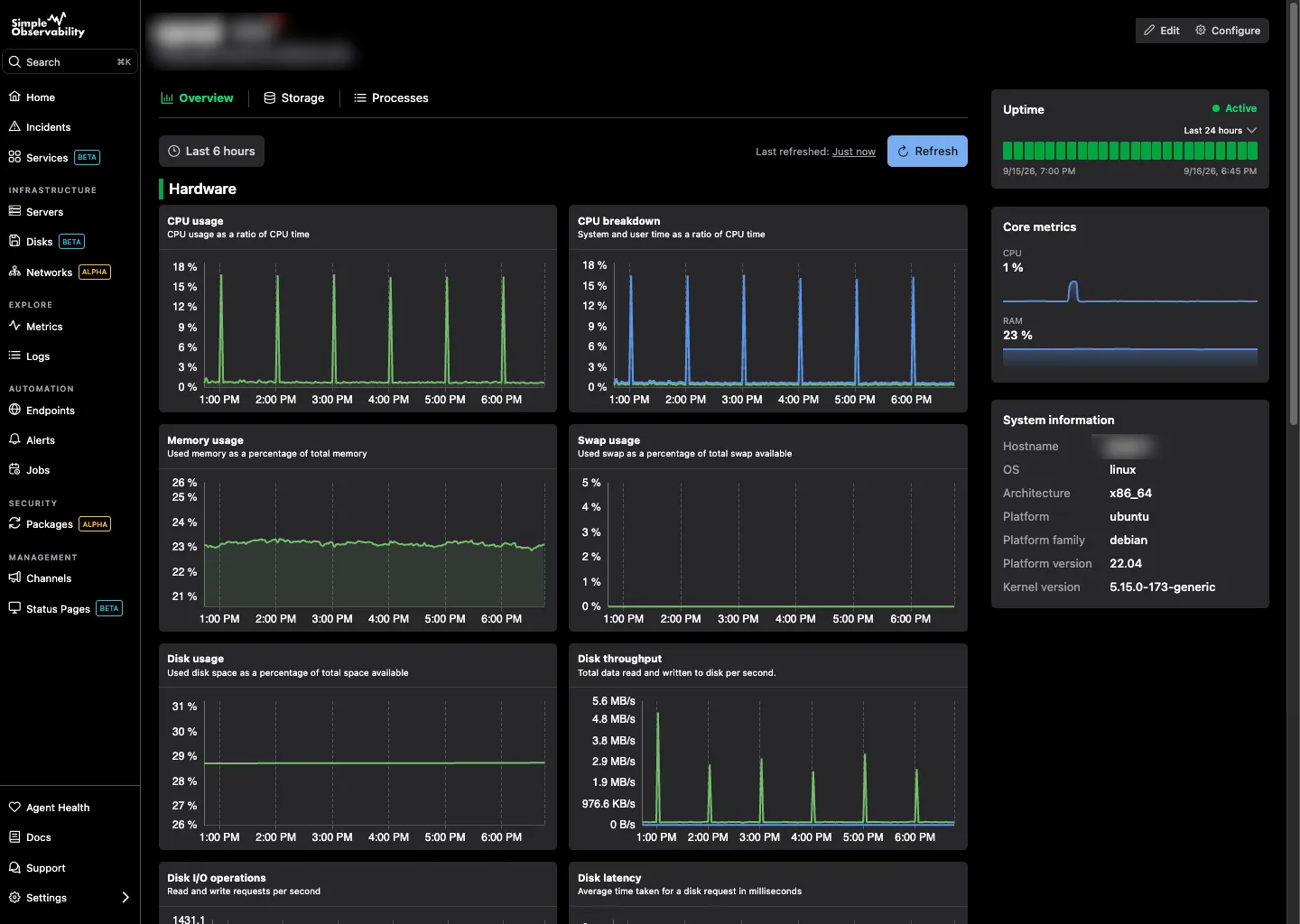
Simple Observability is built for teams that have outgrown basic cloud-native tools but don’t want the overhead of an enterprise platform. It focuses on “time to visibility,” replacing complex YAML configuration with a single-command install that works across any cloud or on-prem server.
Why it ranks highly: Most cloud based monitoring tools require you to be an expert in their specific query language. Simple Observability takes the opposite approach, providing sensible defaults for alerts and dashboards immediately. It treats metrics and logs as two sides of the same coin, showing them in a unified view by default.
Pros
- Zero-config installation: A single binary agent discovers everything.
- Predictable cost: Host-based pricing ($3/mo/server) prevents budget surprises.
- Mobile-first: A full PWA for managing incidents from your phone.
Cons
- Fewer “niche” integrations compared to 10-year-old giants.
Price: Free for 1 server; $3/mo per server for unlimited fleets.
2. Datadog
Datadog is the undisputed heavyweight of the SaaS monitoring world. It is the tool of choice for organizations that need to see everything — from security logs to network flow to serverless performance — in a single dashboard.
Pros
- Massive ecosystem: Over 600 integrations covering every possible cloud service.
- Unified platform: Truly integrates metrics, logs, and traces.
- Watchdog AI: Genuinely useful for spotting outliers in massive datasets.
Cons
- High cost: Ingestion fees and custom metric costs can quickly exceed your primary cloud bill.
- Complexity: Requires a significant time investment to master.
Best for: Large enterprises with dedicated observability teams.
3. New Relic
New Relic has transitioned into an “all-in-one” data platform. It excels when you need to understand the relationship between application code performance and the underlying cloud infrastructure.
Pros
- Excellent APM: Deep visibility into how your code executes in production.
- Generous free tier: 100 GB of data ingestion per month for free.
- NRQL query power: Extremely flexible for building custom business-logic dashboards.
Cons
- The UI can be cluttered and difficult for new users to navigate.
- Per-user seat pricing can make it expensive as the team grows.
4. Dynatrace
Dynatrace is designed for teams that want the tool to do the thinking. Its “Davis” AI engine doesn’t just alert you that there is a problem; it attempts to pinpoint the exact root cause by analyzing the entire topology of your cloud stack.
Pros
- Automated root cause: Reduces “blame-storming” during incident calls.
- Full-stack discovery: Automatically maps dependencies between services.
Cons
- Enterprise-focused pricing that is often out of reach for smaller startups.
- High learning curve for advanced automation features.
5. Grafana Cloud
For teams that love open-source standards but don’t want to host their own Prometheus, Loki, and Tempo instances, Grafana Cloud is the logical choice.
Pros
- No vendor lock-in: Uses standard PromQL and LogQL.
- Stunning visualizations: The gold standard for dashboard aesthetics.
Cons
- Managing your own “metric sprawl” still requires effort even if the database is managed.
- Loki (logs) can be difficult to query compared to structured search tools.
6. AWS CloudWatch / Azure Monitor
These are the “native” options. They are already running, and they collect basic metrics and logs the second you spin up a resource.
Pros
- Zero setup: Most basic metrics are collected by default.
- IAM integration: No external roles or keys to manage.
Cons
- Multi-cloud blind spots: They are painful to use if you have resources in other clouds.
- Basic UI: They often lack the sophisticated correlation and AI features of 3rd party tools.
Why “zero-config” matters in the cloud
Cloud infrastructure is ephemeral. In a single day, an auto-scaling group might spin up 50 instances and terminate them four hours later. If your monitoring tool requires manual agent configuration or “allow-listing” for every new host, your visibility will always lag behind reality.
Zero-config tools use auto-discovery to detect when new services appear. This is critical for microservices architectures where “who owns this service?” is a common question during a 2 am outage. When the tool handles discovery, your team can focus on fixing the bug instead of fixing the monitor.
Managing the “monitoring tax”
The “monitoring tax” is the hidden cost of observability. It includes the subscription fee, the data transfer costs, and most importantly, the engineering hours spent maintaining the system.
In 2026, the trend is moving away from “more data” and toward “better signal.” Choosing a tool that provides a unified view of logs and metrics out of the box — like Simple Observability — reduces this tax by eliminating the need to build custom integrations between separate tools.
Choosing the right tool for your cloud
Your choice should depend on where you are in your journey:
- The AWS/Azure Only Shop: Stick with native tools until you feel the pain of limited correlation.
- The High-Growth Startup: Look for zero-config SaaS tools like Simple Observability that grow with you without requiring a DevOps hire.
- The Global Enterprise: Invest in Datadog or Dynatrace if you have the budget to support their complexity.
The best cloud based monitoring tool is the one that disappears into your workflow, only showing up when it has something important to say.